Game library · 18+
Every table has a language.
Use these guides to understand the sequence of play, the meaningful choices, the mathematical cost and the history behind six enduring casino games. This is education—not an invitation to gamble.
Browse by format
Choose a game to decode.
Complexity describes the number of rules and choices to learn—not safety, profitability or the likelihood of winning.

Roulette
Inside and outside wagers, wheel variants, payout logic, the history of zero and the gambler's fallacy.
Open complete guide →
Blackjack
Hand values, hit/stand/double/split decisions, dealer rules, payout variants and strategy limits.
Open complete guide →
Baccarat
Player, Banker and Tie; punto banco procedures; third-card logic; commission; scoreboards and myths.
Open complete guide →
Craps
Come-out rolls, point cycles, pass and don't pass, odds wagers, proposition bets and table etiquette.
Open complete guide →
Casino Poker
Three Card Poker, Caribbean Stud, hand rankings, ante/play structures and side-bet pricing.
Open complete guide →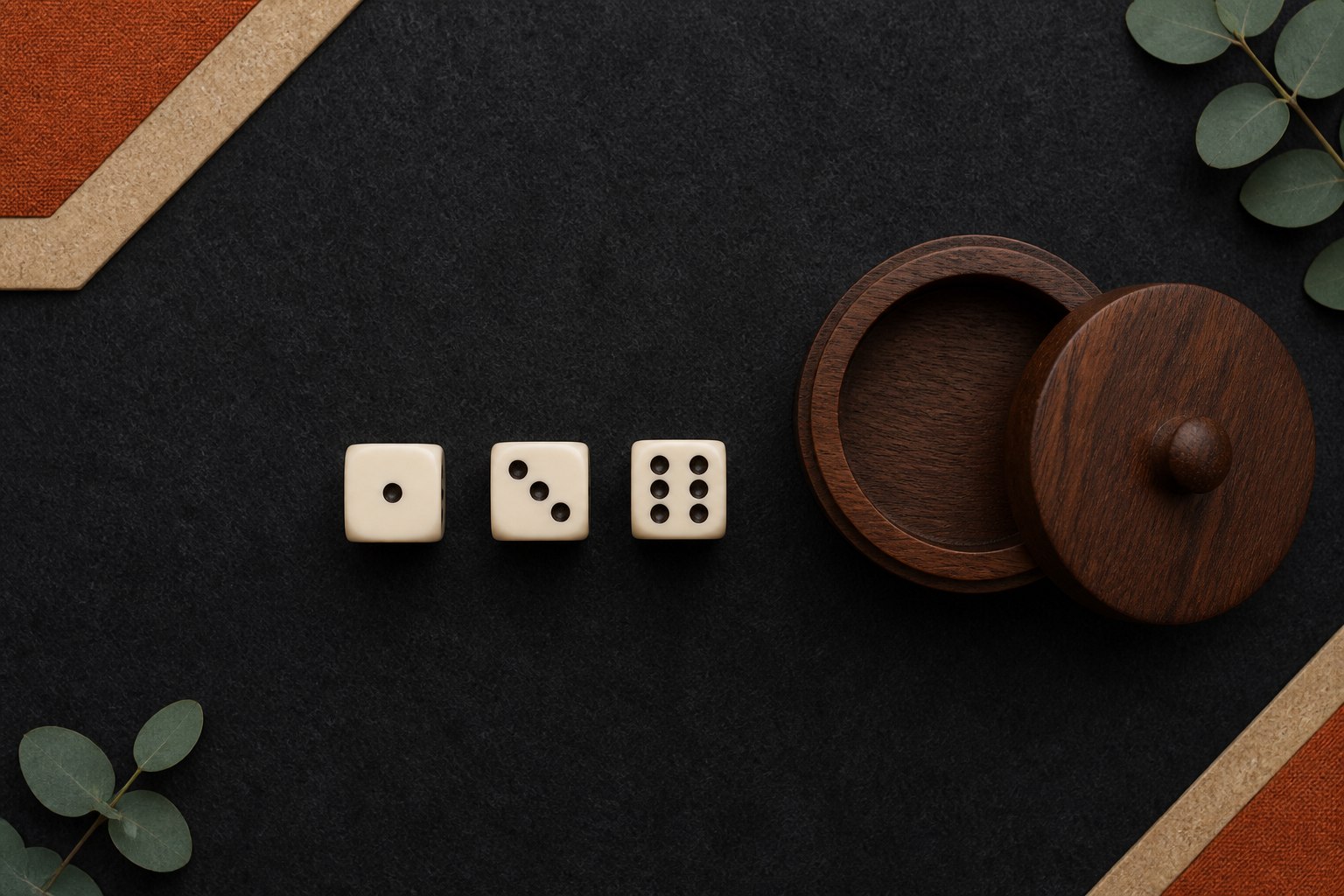
Sic Bo
Small/big, totals, doubles, triples and the dramatic range of house edges across a single layout.
Open complete guide →At a glance
Compare the structures.
Figures are representative examples. Rules and payouts at a particular venue can materially change the mathematical cost.
| Game | Core mechanism | Player decisions | Representative lower-edge wager | Important variation |
|---|---|---|---|---|
| Roulette | Ball lands in numbered pocket | Wager selection only | 2.70% on European single-zero bets | American double-zero raises edge to 5.26% |
| Blackjack | Build a hand near 21 | Hit, stand, double, split; sometimes surrender | Often below 1% with favourable rules and accurate basic strategy | A 6:5 blackjack payout is materially worse than 3:2 |
| Baccarat | Closest final total to 9 | Choose Player, Banker or Tie | About 1.06% on standard Banker (5% commission) | Tie usually carries a much higher edge |
| Craps | Two-dice sequence with a point | Choose among many wagers | About 1.36% on Don't Pass; 1.41% on Pass Line | One-roll propositions can be far more costly |
| Casino Poker | Player hand compared with dealer | Fold or continue after viewing cards | Varies substantially by variant and strategy | Side bets often have separate, higher edges |
| Sic Bo | Total and patterns from three dice | Wager selection only | Often around 2.78% on Small/Big under common rules | Specific triples may exceed 16% house edge |
House edge is a long-run theoretical average. Any short session can produce a win or a loss, and no listed choice removes financial risk.
A useful reading order
Rules first. Payouts second. Risk always.
Begin with the game's objective and sequence. Then examine the exact paytable, identify optional side bets and compare the advertised payout with the real probability.
Finally, decide whether participating fits a pre-set entertainment budget. If the answer is uncertain, not playing is the clearest decision.